Parma, Much More Than Parmigiano and Prosciutto
Forget the usual crowded, glossy destinations. This year, let yourself be drawn to the beating heart of Emilia-Romagna: Parma, a city that will win you over with its quiet beauty and flavours that linger in the memory. Perhaps you know it for Parmigiano Reggiano DOP and prosciutto di Parma DOP, the true excellences that have made it world-famous. But Parma is much, much more. It is an Italian gem waiting to be discovered, a human-scale city in which art, history and gastronomy come together in unique harmony.

Often underrated compared to Italy's more celebrated art cities, Parma guards a priceless heritage, a hidden treasure that reveals itself slowly, around every corner, with every taste. Prepare to be amazed by the wealth of its Romanesque art, the grandeur of its theatres, the elegance of its historic centre and, of course, the richness of its gastronomic tradition. Parma is a promise of authenticity, an experience beyond expectations, a journey that will leave a lasting mark on your heart. If you are looking for an Italian destination that can surprise, move and delight you, then Parma is the answer. Let us guide you on this journey to discover what to see in Parma, and prepare to fall in love with this extraordinary city.
Immerse Yourself in Art and History: Parma's Must-See Monuments
Parma is a true treasure chest of art and history, a stage on which centuries of culture have been layered, leaving lasting traces. Prepare for a journey through time to discover monuments that will take your breath away, witnesses to a glorious past that still vibrates through the streets of the historic centre.
The Duomo and the Baptistery: Romanesque Jewels That Take Your Breath Away

Anyone arriving in Parma cannot help but be enchanted by Piazza Duomo, a true compendium of Romanesque art. Here, the Duomo and the Baptistery rise up in all their majesty, witnesses to an ancient faith and timeless artistic mastery. The Duomo, with its imposing facade and bell tower reaching towards the sky, welcomes you with the solemnity of its forms. As you enter, you are wrapped in sacred half-light, lit by the glow filtering through the stained glass and caressing the thousand-year-old columns. Look up to the dome, frescoed by Correggio with the visionary "Assumption of the Virgin", a masterpiece that will make you feel small and at the same time part of something grand.
And then there is the Baptistery, an octagonal building of pink Verona marble, a true architectural jewel. Outside, the layered loggias and sculpted portals tell stories of saints and prophets. Inside, allow yourself to be captivated by the frescoed vault, a 13th-century pictorial cycle that will draw you into a universe of colour and symbolism. Walking between the Duomo and the Baptistery is like leafing through an open-air book on art history, an experience that nourishes both soul and mind.
Teatro Farnese: A Wooden Theatre That Feels Like a Mirage
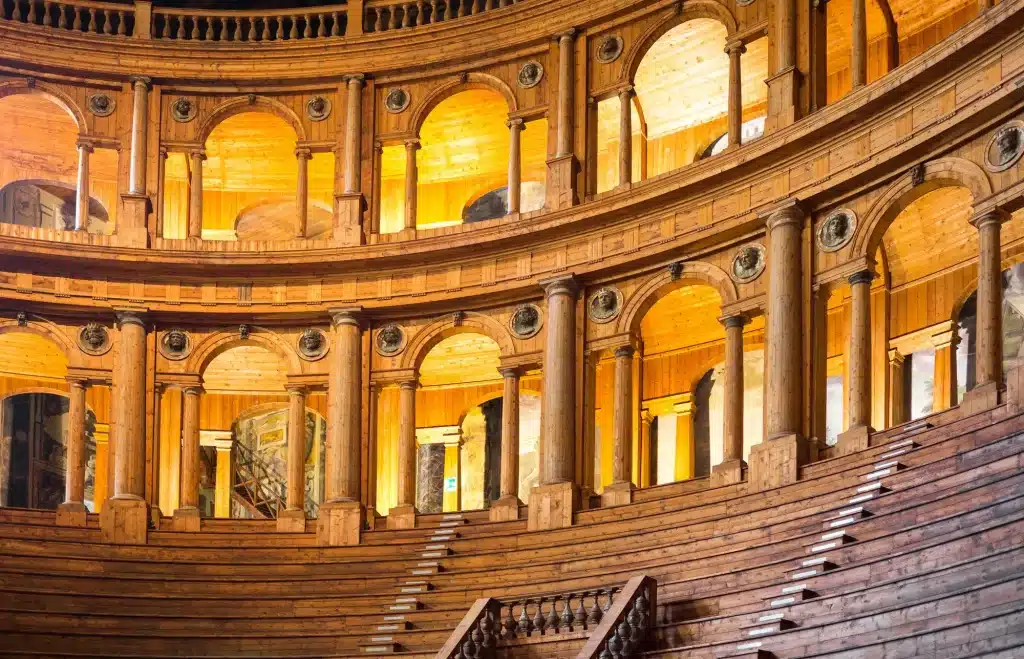
Prepare for a unique, almost surreal experience as you step into the Teatro Farnese. Hidden inside the Palazzo della Pilotta, this wooden theatre will appear before you like a mirage, a scenographic illusion transporting you to another era. Built entirely in wood in the 17th century to celebrate a visit by the Grand Duke of Tuscany, the Teatro Farnese is a masterpiece of Baroque engineering and stagecraft. Its imposing dimensions, the illusionistic perspective of the stage and the decorations imitating marble and stucco all combine to create a magical, theatrical atmosphere.
Imagine the lavish performances that once animated this place: mythological scenes, naval battles staged in the floodable arena. Today, the Teatro Farnese is a one-of-a-kind monument, a precious treasure bearing witness to the grandeur of the Farnese court and the genius of the artists who created it. Walking through its stalls, admiring the loggias and the upper gallery, is an experience that will leave you speechless, a journey back in time that you will not easily forget.
Piazza Duomo and the Historic Centre: Walking in Beauty

But Parma is not only about isolated monuments; it is above all a lively, charming historic centre, a labyrinth of streets and alleys inviting strolling and discovery. Piazza Duomo is the beating heart of the city, the ideal starting point for immersing yourself in Parma's atmosphere. From here, follow your instinct, get lost in the cobbled streets, admire the colourful facades of historic palazzi, allow yourself to be surprised by the hidden churches and artisan workshops.
Stroll under the porticoes, take refuge in the shade on warm summer days, and let yourself be charmed by this city's quiet appeal. Discover Piazza Garibaldi, with the Palazzo del Governatore and the Town Hall, admire the Palazzo del Comune with its civic tower, and let yourself be enchanted by the beauty of Piazza della Pilotta, with its museums and the Parco Ducale, a green oasis at the heart of the city. Parma's historic centre is an open-air museum, a place where beauty is everywhere - you simply need to look for it and savour it.
Parma Food Valley: A Paradise for the Palate
Parma is synonymous with gastronomic excellence, a true paradise for the palate. It is no coincidence that it is known as the Italian Food Valley, a region in which a passion for food has been handed down through generations, giving rise to unique products celebrated around the world. Prepare for a sensory journey through Parma's authentic flavours, an experience that will engage all your senses and leave a lasting memory.
Parmigiano Reggiano: The King of Cheeses

Begin this gastronomic journey with the king of cheeses: Parmigiano Reggiano DOP. A product that is far more than a simple cheese - it is a symbol of a territory, of a thousand-year tradition, of artisan passion. Its history reaches back to the Middle Ages, when Benedictine monks first began producing it; ever since, the recipe and method have remained virtually unchanged. Witnessing the birth of Parmigiano Reggiano is a moving experience, a ritual that is repeated every day in the dairies of the area. Freshly drawn milk, the skill of the cheesemakers, the long ageing - everything works together to create a unique product with an intense, unmistakable flavour.
Don't just taste Parmigiano Reggiano - experience it in full. Visit a dairy, discover the secrets of its production, take part in a guided tasting that will reveal the different shades of flavour and aroma at various stages of ageing. Pair Parmigiano Reggiano with a glass of local wine, such as Lambrusco or Malvasia, and let yourself be conquered by a combination of flavours that will make you fall in love with Parma.
Prosciutto di Parma: Sweetness and Tradition

After the king of cheeses, here comes the prince of cured meats: prosciutto di Parma DOP. Another symbol of Parma's gastronomic excellence, a product distinguished by its delicate sweetness, unmistakable fragrance and soft, velvety texture. Prosciutto di Parma also has an ancient history, tied to peasant tradition and the skill of breeders and curers. Its production is a precise and rigorous ritual, following an extremely strict set of rules that guarantee the quality and authenticity of the product.
Tasting a slice of prosciutto di Parma is a unique sensory experience. Allow yourself to be won over by its intense, inviting aroma, its sweet, lightly savoury flavour and its melt-in-the-mouth texture. Enjoy it on its own, with home-style bread or a slice of melon, or use it to enrich your dishes - from primi to secondi, antipasti to side dishes. To savour prosciutto di Parma at its best, choose a typical trattoria or a traditional osteria, where you can pair it with other local specialities and a good glass of wine.
Not Just Parmigiano and Prosciutto: Parma's Other Delights
But Parma's Food Valley does not end at Parmigiano Reggiano and prosciutto. Explore the other delights this land has to offer. Try the tortelli di erbetta, fresh pasta filled with ricotta and chard, a simple yet flavour-packed dish. Be won over by anolini in broth, small rings of stuffed pasta served in a rich, tasty meat broth - perfect comfort food for cooler days. Discover torta fritta, a puffed, fried bread that pairs beautifully with cured meats and cheeses. And don't forget the wines of the Colli di Parma, whites and reds with bold character and intense aroma, perfect to accompany the dishes of the Parma tradition.
For an authentic culinary experience, lose yourself in the local markets, where you can find fresh, genuine produce direct from the growers. Step into the historic shops, where you can buy artisanal specialities and chat with the owners, passionate guardians of Parma's gastronomic tradition. Parma is a city to savour in every sense, a place where food is culture, history and passion.
Parma Experience: Practical Tips for an Unforgettable Trip
To make the most of your Parma Experience, here are some practical tips to help you plan your trip and enjoy everything this city has to offer.
When to Go to Parma: The Best Time of Year
Parma is beautiful in every season, but the best time to visit is spring and autumn. In these months, the climate is mild and pleasant, ideal for strolling through the historic centre and enjoying outdoor activities. In spring, the city wakes up, parks fill with flowers and the days grow longer, inviting you to experience every corner of the city. In autumn, the warm colours of nature wrap Parma in a magical, evocative atmosphere, while sagre and village fairs celebrate the typical produce of the season.

Summer in Parma can be hot and humid, but it is also the ideal time to enjoy outdoor evenings, concerts and cultural events that animate the city. Winter is colder and damper, but it has its own charm, especially during the Christmas season, when Parma lights up with colour and the atmosphere becomes magical and evocative. Whatever the season, Parma will always welcome you with its warmth and hospitality, offering an unforgettable experience at any time of year.
How to Get to and Around Parma
Parma is easy to reach by various means of transport. If you are travelling by plane, the "Giuseppe Verdi" Parma Airport is just a few kilometres from the city centre, with connections to several Italian and European cities. Alternatively, you can land at Bologna "Guglielmo Marconi" Airport, which is well connected to Parma by train or bus. If you prefer the train, Parma Station is in the heart of the city and is served by numerous national and regional rail lines. Driving is also an excellent option for reaching Parma, thanks to the A1 Milan-Naples and the A15 Parma-La Spezia, which connect it to Italy's main cities.

Once you arrive in Parma, getting around is easy and pleasant. The historic centre is compact and easily explored on foot. To reach more peripheral areas or move more quickly, you can use the urban buses, which cover the whole city and the surrounding area. If you prefer cycling, Parma is a bike-friendly city, with numerous cycle lanes and bike-sharing services. If you arrive by car, we recommend parking outside the historic centre and using the free park-and-ride sites, connected to the centre by public transport.

Where to Stay in Parma: Suggestions for Every Budget

Parma offers accommodation for every taste and budget. If you are looking for the height of comfort and elegance, you can choose one of the luxury hotels in the historic centre, set in beautifully restored historic buildings. If you prefer a more family-friendly, welcoming atmosphere, you can opt for a bed & breakfast or a guest house, often set in historic buildings or charming homes. For a stay surrounded by nature, you can choose an agriturismo in the Parma hills, where you can sample the typical produce of the area and enjoy the peace of the countryside.
If you are travelling on a limited budget, you can find budget hotels and hostels in central locations or easily reached by public transport. Parma also offers apartments and holiday homes, ideal for those seeking more space and independence, especially when travelling with family or in a group. Whatever your choice, we recommend booking in advance, especially in high season or during events, to secure the best accommodation at the best price.
Parma Awaits, Ready to Surprise You!
Parma is a city that enters your heart slowly but inexorably. It is a city that does not reveal itself at once, but invites you to discover it at leisure, guided by curiosity and the desire to explore. It is a city that can surprise, move and delight, offering an authentic and unforgettable experience. From Romanesque art to the Food Valley, from the lively historic centre to the relaxed atmosphere, Parma is an Italian gem waiting to be discovered. A destination worth visiting, not only for Parmigiano Reggiano and prosciutto, but for its quiet beauty, cultural richness, gastronomic excellence and welcoming atmosphere. Parma is a promise of authenticity, a journey that will leave a lasting mark on your heart.
Have you visited Parma? If you have never been, what intrigues you most about this city? Share your experience in the comments!
Frequently Asked Questions (FAQ)
What makes Parma so special?
Parma is special for its incredible combination of art, history and gastronomy. It is a city rich in breathtaking Romanesque monuments, unique historic theatres and a charming historic centre, but it is also the capital of the Italian Food Valley, home to outstanding products such as Parmigiano Reggiano and prosciutto di Parma. The perfect mix for an unforgettable travel experience.
How long does it take to visit Parma?
To visit Parma's main attractions, a weekend is enough. If you wish to explore the city and its surroundings in greater depth, including gastronomy and local experiences, we recommend 3-4 days. With a week, you can explore Parma and its treasures at leisure, fully enjoying the atmosphere and flavours of this extraordinary city.
What must I eat in Parma?
You absolutely must try Parmigiano Reggiano and prosciutto di Parma, the unrivalled symbols of local gastronomy. Don't miss tortelli di erbetta, anolini in broth, torta fritta and the other specialities of typical Parma cuisine. Pair them with a glass of Colli di Parma wine for a complete food and wine experience. Take a look at our selected list of restaurants in Parma!
Is Parma suitable for children?
Yes, Parma is a perfect city for families with children. The historic centre is easily explored on foot, there are parks and gardens where children can play, and many museums offer activities and educational trails for younger visitors. Parma's gastronomy is also rich in simple, tasty dishes that children will enjoy.
What is the best time to visit Parma to avoid the crowds?
To avoid the crowds, the best months are April-May and September-October. In these periods, the climate is mild and pleasant, and the city is less busy than during the summer months and bank holidays. The winter months, excluding the festive periods, can also be a good time to visit Parma, allowing you to enjoy the city's quiet, atmospheric mood.