Parma, a city of art and culture in the heart of Emilia-Romagna, offers a unique experience for visitors. With seven days at your disposal, you will have time to explore every corner of this fascinating place. From historic monuments to culinary delights, Parma will win you over with its timeless charm.
Parma's historic centre is a true jewel, with the Duomo and the Baptistery dominating Piazza del Duomo. Strolling through the cobbled streets, you will discover Renaissance palazzi, Baroque churches and picturesque squares. Don't forget to visit the Teatro Farnese, an architectural masterpiece in wood.
Parma cuisine is famous around the world. Prosciutto di Parma DOP, Parmigiano Reggiano DOP and tortelli di erbetta are just some of the specialities to try. With a week at your disposal, you will have time to savour these authentic flavours and discover the secrets of the local gastronomy.

The Heart of Parma: Piazza Duomo and surroundings
Piazza Duomo is the historic and cultural centre of Parma. Some of the city's most important monuments are found here, witnesses to centuries of history and art.
Parma Cathedral and the Baptistery

Parma Cathedral, a jewel of Romanesque architecture, dominates the square. Its white marble facade is rich in sculpted detail. Inside, the dome frescoed by Correggio takes visitors' breath away.
Next to the Cathedral stands the Baptistery, an octagonal building of pink Verona marble. Its external sculptures and internal frescoes tell biblical stories and scenes from the life of Christ.
These two monuments represent the spiritual heart of the city and are an essential stop for anyone visiting Parma.
Address: Piazza Duomo, 7, 43121 Parma PR
Telephone: 0521235886
Maps link: https://maps.app.goo.gl/xw8goY61jNWNkPKf8
The Bishop's Palace and the Biblioteca Palatina
The Bishop's Palace, the residence of the Bishop of Parma, faces the square with its imposing Baroque facade. Inside is the Biblioteca Palatina, a treasure of culture and learning.
The library houses over 700,000 volumes, including precious manuscripts and incunabula. Its rooms decorated with frescoes and stuccoes are a real spectacle for the eyes.
The library can be visited by appointment, allowing you to admire some of its most precious treasures.
Address: Vicolo Vescovado, 3, 43121 Parma PR
Maps link: https://maps.app.goo.gl/thzZd4Y4EzZd5Wse7
Teatro Farnese and the National Archaeological Museum
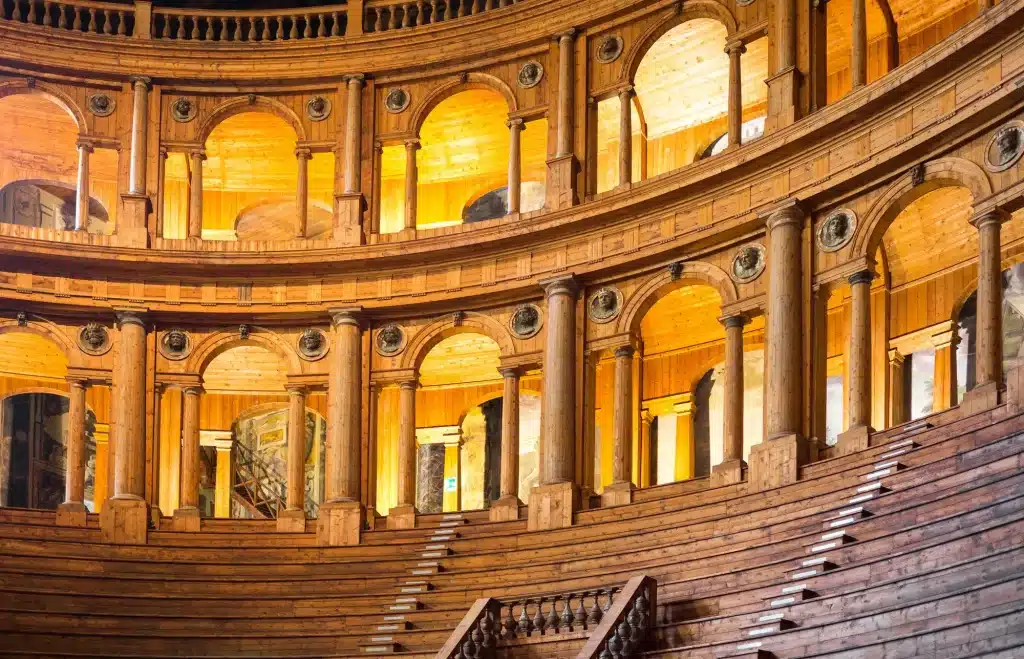
A few steps from Piazza Duomo stands the Palazzo della Pilotta, which houses the Teatro Farnese and the National Archaeological Museum.
The Teatro Farnese, built entirely in wood, is a masterpiece of Baroque architecture. Its unique structure and elaborate decorations make it one of the most beautiful theatres in Italy.
The National Archaeological Museum displays finds telling the history of Parma from the Bronze Age to the Roman period. Among the most important pieces are the Tabula Alimentaria of Veleia and the Victoriato of Livia.
These places offer a fascinating insight into the rich history of Parma and its region.
Address: At the Pilotta Monumental Complex, Piazza della Pilotta, 15, 43121 Parma PR
Telephone: 0521233617
Maps link: https://maps.app.goo.gl/gA27vTCCZhLjd9LG6
Website: https://complessopilotta.it/
Gastronomic Route: Parma's Delights
Parma is a paradise for food lovers. The city offers a variety of unique flavours that tell its history and culinary tradition.
Discovering Parmigiano Reggiano

Parmigiano Reggiano DOP is the king of Parma's cheeses. A visit to a local dairy is an experience not to be missed. Visitors can see how milk is transformed into cheese.
The production process is fascinating. Expert cheesemakers work the fresh milk with care, using techniques handed down through the generations.
Visitors can taste Parmigiano Reggiano of different ageings. The flavour changes with time, becoming more intense and complex.
Many tours offer the chance to buy the cheese directly from the producer. It is the perfect souvenir to take home.
Prosciutto di Parma: a tour of taste and tradition

Prosciutto di Parma DOP is famous around the world. A visit to a curing house is a must for any meat lover.
Visitors can see the various stages of production. Salting, ageing and quality control are crucial steps.
The air of the Parma hills plays an important role in production, giving the prosciutto its unique flavour.
Many tours include a tasting. It is the perfect chance to savour the prosciutto sliced by hand.
Visitors can also learn how to pair prosciutto with other local products. Fruit, cheeses and wines make excellent companions.
Wine bars and osterie: where to enjoy local wines
Parma has a rich wine tradition. The city's wine bars and osterie are the ideal places to discover it.
Malvasia dei Colli di Parma is one of the most famous wines in the area. It is a sparkling white, perfect for an aperitivo.
Many osterie offer guided tastings - a fun way to learn about local wines.
The sommeliers explain the characteristics of each wine and discuss pairings with the typical foods of Parma.
Some wine bars organise tours of nearby vineyards. It's a great excuse to explore the beautiful hills around the city.
Between Art and Music: a cultural itinerary
Parma is a city rich in artistic and musical treasures. This itinerary will lead you to discover the most fascinating places of Parma's culture.
The Casa della Musica and the Teatro Regio

The Casa della Musica is the perfect starting point for music lovers. Here you can explore interactive exhibitions on Parma's musical history. The museum houses ancient instruments and memorabilia of famous composers.
The Teatro Regio is a jewel of neoclassical architecture. Built in 1829, it is famous for its perfect acoustics. Guided tours allow visitors to admire the splendid interiors and the historic curtain.
During the opera season, the theatre stages high-quality performances. You can attend operas by Verdi, much loved by the Parma public.
Galleria Nazionale and the art treasures

The Galleria Nazionale is housed inside the Palazzo della Pilotta. It holds an impressive collection of works from the Middle Ages to the 20th century.
Among the most famous masterpieces is Leonardo da Vinci's "Scapigliata". There is no shortage of works by Correggio, Parmigianino and other Italian masters.
The palazzo also houses the Teatro Farnese, a 17th-century wooden theatre. It is a unique example of Baroque theatrical architecture.
A walk through literary Parma: places and anecdotes

Parma has inspired many famous writers. A walk through the historic centre reveals the places linked to literature.
The birthplace of Attilio Bertolucci is now a museum dedicated to the poet. It is located near the Baptistery, another symbol of the city.
The Parco Ducale was Stendhal's favourite place during his stay in Parma. Here he wrote part of his novel "The Charterhouse of Parma".
Not far away is the Caffè Pepèn, frequented by Giovannino Guareschi. The author of "Don Camillo" loved to sit here to observe city life.
Relaxing in green spaces: Parma's parks and gardens
Parma offers many green spaces for relaxing and enjoying nature. These places are perfect for a break from the city and to admire its natural beauty.
Parco Ducale and Ponte Verdi
Parco Ducale is a green jewel in the heart of Parma. This large historic park dates back to the 16th century and offers wide tree-lined avenues, perfect for peaceful walks.
Visitors can admire splendid fountains and ancient statues scattered through the park. There is also a picturesque pond where you can see ducks and swans.
The Ponte Verdi, near the park, offers a panoramic view over the River Parma. It is an ideal spot to take photos and watch the sunset.
At weekends, the park comes alive with families and groups of friends having picnics on the grass.
Botanical Garden and Giardino Ducale

Parma's Botanical Garden is a hidden treasure for nature lovers. Founded in 1770, it houses a vast collection of rare and exotic plants.
Visitors can explore tropical greenhouses, herb gardens and an arboretum with centuries-old trees. It is a peaceful place to learn about biodiversity.
The Giardino Ducale, adjacent to the Botanical Garden, is an example of an Italian-style garden. It features geometric flower beds, well-kept hedges and elegant fountains.
These green spaces offer a refuge from the bustle of the city. They are perfect for reading a book, doing yoga or simply relaxing in the sun.
Frequently Asked Questions
Here are some answers to the most common questions about what to see and do in Parma. You will find useful tips for organising your visit, whether you have just one day or more time at your disposal.
What is the best itinerary for visiting Parma in a day?
To see the best of Parma in a day, you can start from the Duomo and the Baptistery in Piazza Duomo. Then continue towards the Palazzo della Pilotta and the Teatro Farnese inside it.
In the afternoon, a stroll through the historic centre allows you to admire the Basilica di Santa Maria della Steccata and Piazza Garibaldi. The day can end with a visit to Parco Ducale.
What are the unmissable places to see during a weekend in Parma?
On a weekend in Parma, in addition to the monuments of the centre, you can visit the Camera di San Paolo with its Correggio frescoes and the Abbey of San Giovanni Evangelista.
It is also worth dedicating time to the Teatro Regio and the Glauco Lombardi Museum. For food lovers, a stop at a Parmigiano Reggiano dairy is a must.
What can I visit free of charge in Parma?
Parma has several places that can be visited free of charge. Churches such as the Church of San Giovanni Evangelista are free to enter.
Parco Ducale and the public gardens also require no ticket. On certain days of the month, some museums offer free admission.
What attractions do you recommend in and around Parma if I only have 3 days?
With three days at your disposal, in addition to central Parma, you can take a trip to the Rocca di Fontanellato or the Labirinto della Masone by Franco Maria Ricci.
Another option is to visit the Castello di Torrechiara. Food lovers can devote half a day to a gastronomic tour of dairies and curing houses.
How long should I spend visiting the Castello di Bardi?
To visit the Castello di Bardi properly you need around 2-3 hours. This allows time to explore the interior rooms, the towers and the patrol walks.
If you also wish to walk in the surrounding area or have lunch nearby, it is best to plan for half a day.
What are some unusual or lesser-known places to explore in Parma?
Among the lesser-known places in Parma are the Botanical Garden and the ancient Ospedale Vecchio. The Church of Santa Maria del Quartiere with its frescoes is also worth a visit.
Outside the city, the village of Vigoleno and the Abbey of Fontevivo are interesting and uncrowded destinations.